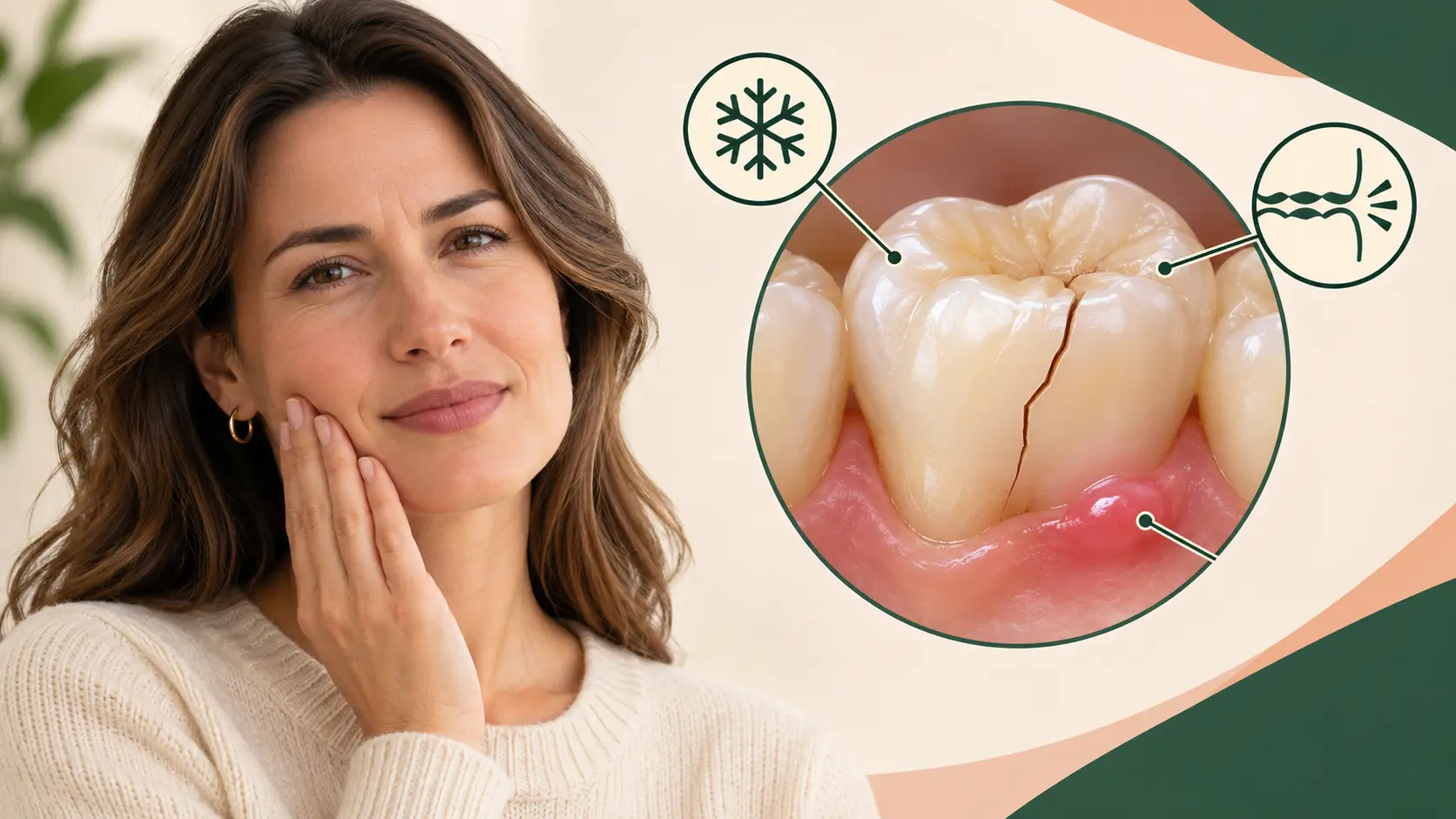
A cracked tooth is a small break in the tooth that can start on the chewing surface and move toward the root. Cracks are very common in adult teeth, and they can be hard to figure out because the pain does not act the way you expect. One day it hurts, the next day it feels fine. This guide covers the main cracked tooth symptoms, which ones are urgent, and what a dentist can do about them.
At Marketplace Dental Excellence in Queen Creek, AZ, patients can get an exam to find out why a tooth hurts and whether it has a crack. What your symptoms mean depends on a few things, like how deep the crack goes, which tooth is affected, how you bite, and habits such as grinding your teeth.
Types of Cracked Teeth
Five main types of cracked teeth are craze lines, fractured cusp, cracked tooth, split tooth, and vertical root fracture. They range from harmless to serious. Each one feels a little different.
Craze Lines
Craze lines are tiny cracks in the outer enamel, and they usually do not hurt. Most adults have a few. They are mostly a surface issue and often need no treatment.
Fractured Cusp
A fractured cusp is when a pointed part of the chewing surface breaks off. It can hurt when you bite, but the sensitive part inside is often not affected. A dentist can usually fix it with a filling or a crown.
Cracked Tooth
A cracked tooth has a crack that runs from the chewing surface down toward the root. This type can hurt when you bite and when you drink something cold. If the crack reaches the inner part of the tooth, the pain can get stronger.
Split Tooth
A split tooth has a crack that goes all the way through, so the tooth is in two parts. It is often painful, and the tooth cannot always be saved in one piece.
Vertical Root Fracture
A vertical root fracture starts in the root and moves up. It may not hurt much at first. Later you may notice gum swelling or signs of infection. These cracks are the hardest to save.
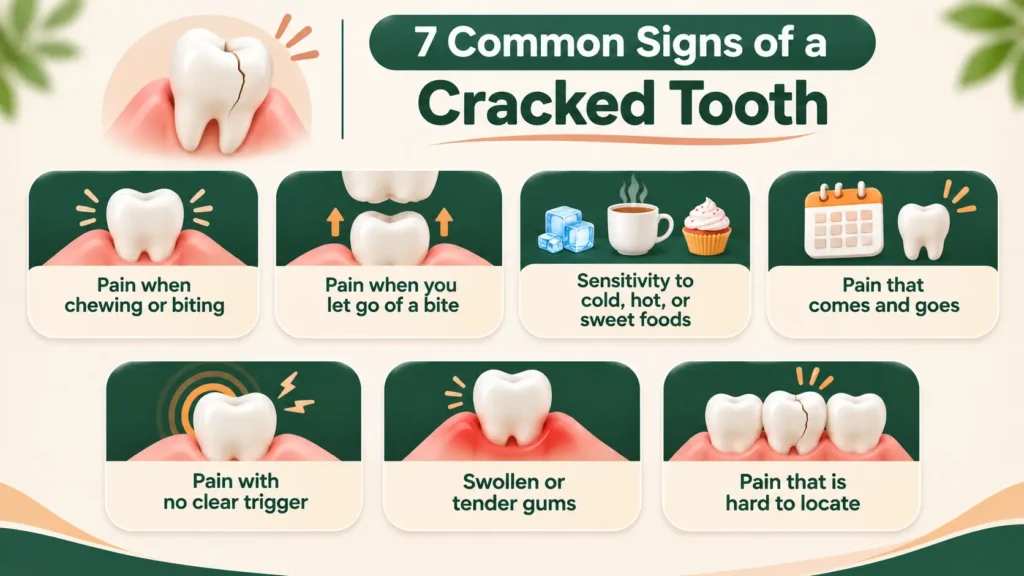
7 Common Cracked Tooth Symptoms
The most common signs are cold sensitivity and pain when you bite. Here are all seven, so you know what to watch for.
1. Pain When Chewing or Biting
Sharp pain when you bite down is one of the best-known signs of a crack. The cracked parts of the tooth can move slightly under pressure, causing pain and irritation. You may feel it only when eating certain foods or biting in one spot.
2. Pain When You Let Go of a Bite
Some cracked teeth hurt more when you release your bite than when you bite down. As you chew, the cracked parts of the tooth may move slightly, causing a sudden, sharp pain when you release the pressure. This often happens when eating hard or chewy foods.
3. Sensitivity to Cold, Hot, or Sweet Foods
Yes, a crack can make a tooth sensitive to temperature and sugar. A crack can let cold, heat, and sweet foods reach the soft inner part of the tooth. The pain is usually sharp and short, and it fades after a few seconds.
4. Pain That Comes and Goes
A cracked tooth may cause pain that comes and goes rather than constant discomfort. You might feel pain while eating or drinking, but the tooth may feel normal for several days or even weeks. Because the pain is not always present, some people delay visiting a dentist.
5. Pain With No Clear Trigger
Tooth pain that starts without an obvious reason may mean the sensitive tissue inside the tooth is inflamed. The pain may feel constant or come in repeated waves, even when you are not eating or drinking. If the pain lasts a long time or keeps you awake at night, contact a dentist as soon as possible.
6. Swollen or Tender Gums
Swelling near a cracked tooth may be a sign of infection. A crack can allow bacteria to enter the tooth, which may lead to an infection that affects the surrounding gums. You may notice a small, raised area on the gum or feel pain when touching the affected area.
7. Pain That Is Hard to Locate
A cracked tooth may cause pain that is difficult to identify. The pain may seem to come from the jaw or from a tooth next to the cracked one. Some people also feel like food is stuck, or feel a rough edge with their tongue.
Which Cracked Tooth Symptom Is the Most Common?
The most common symptom is pain from cold, not pain from biting. Many people think biting pain is the main sign, but that is not what the numbers show. A 2018 Journal of Dentistry study by Hilton and colleagues looked at 2,858 teeth with visible cracks. The dentists were part of a large U.S. research network. The researchers found that 45% of the cracked teeth had some kind of pain. Cold pain was the most common at 37%. Biting pain showed up in 16% of teeth, and pain with no trigger showed up in 11%. This means a tooth that only hurts with cold could still have a crack. It is worth getting checked even if biting feels fine.
Can You Have a Cracked Tooth With No Symptoms?
Yes, you can have a cracked tooth and feel nothing at all. Many cracks, especially small ones, do not cause any pain. A crack you cannot feel can still grow over time. That is one reason regular dental exams matter. Your dentist can spot a crack early, before it turns into a bigger problem.
Cracked Tooth Symptom Checker
Sharp pain, swelling, or throbbing need faster care than brief cold sensitivity. Use this table as a quick guide, not as a diagnosis.
| Symptom | What it may mean | How fast to act |
| Brief cold sensitivity | Early crack or sensitive teeth | Book a visit soon |
| Pain when biting or letting go | A crack that flexes | See a dentist within a few days |
| Throbbing pain with no trigger | The nerve may be inflamed | Call as soon as you can |
| Gum swelling or a bump on the gum | Possible infection | Call the same day |
Why Do Cracked Tooth Symptoms Come and Go?
Pain from a cracked tooth often calms down for a while, but that does not mean the crack is fixed. The crack is still there even when the pain stops. A 2022 Journal of Dentistry study by Funkhouser and colleagues followed 2,858 patients with a visible crack on a back tooth for 3 years. Among teeth that were not treated, more than 9 out of 10 with biting pain or pain with no trigger lost that pain at some point. Cold pain went away in about 68% of the teeth. Pain also came back in some teeth, and about half of the teeth that got new pain lost it again later.
No one knows for sure why this happens. The researchers suggested a few ideas. The tooth may build extra layers inside to protect the sensitive part, or small pieces may fill the crack. Some cold pain may also come from sensitive teeth and not from the crack at all. Either way, pain going away is not a reason to skip the dentist.
What Causes a Cracked Tooth and Who Is at Risk?
Grinding your teeth, chewing hard things, and having large fillings are the main causes and risk factors. Some teeth and some habits make a crack more likely to hurt. A 2017 Journal of the American Dental Association study by Hilton and colleagues looked at 2,975 cracked teeth from 209 dentists. The researchers found that cracked teeth were more likely to hurt in people who clench or grind their teeth. They were also more likely to hurt when the cracked tooth was a molar. Cracks with stains were less likely to cause pain.
Other common causes include:
- Chewing ice, hard candy, or pens
- Large fillings that leave less tooth behind
- A hit to the mouth or a sports injury
- Biting down on something hard by accident
- Wear and age over many years
How Is a Cracked Tooth Diagnosed?
A dentist diagnoses a cracked tooth by examining the tooth, asking about your symptoms, and performing a few tests. During the exam, the dentist will ask when the pain started and what makes it worse. They may use a bright light or magnifying tools to look for small cracks. A bite test helps check whether chewing pressure causes pain, while a cold test shows how the sensitive tissue inside the tooth responds. The dentist may also check the gums for unusual spaces around the tooth and take X-rays to rule out other dental problems. However, small cracks do not always appear on X-rays, so more than one test may be needed.
What Happens If a Cracked Tooth Is Left Untreated?
A crack can get worse, but not every crack does. Some stay the same for a long time, and there is no way to tell which kind you have without a dentist. When a crack does grow, the tooth can break, the nerve can get infected, or the tooth can split. That can turn a simple fix into a bigger one. Early care usually means a simpler and smaller treatment.
Cracked Tooth Treatment Options
The right treatment depends on how deep the crack goes and whether the nerve is hurt. Your dentist will pick the simplest option that protects the tooth.
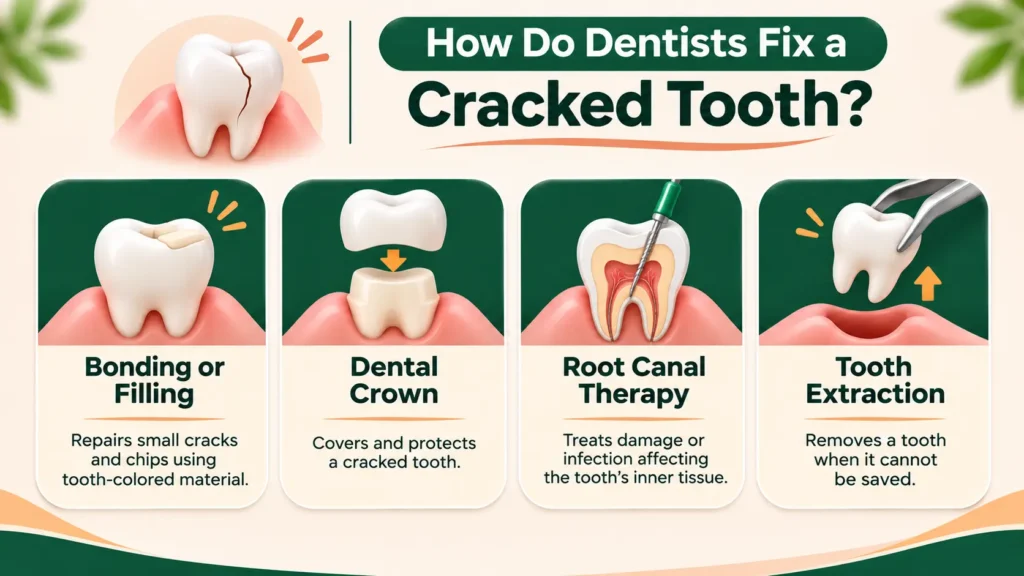
Bonding or Filling
Bonding or a filling works for small cracks and chips. The dentist seals the crack with tooth-colored material. It is usually the simplest treatment, and it often needs only one visit.
Crown
A crown is the most common fix when the crack is larger. It holds the tooth together like a cap. We offer same-day crowns, so you may not need a second visit.
Root Canal Therapy
A root canal is used when the crack has reached the nerve. The dentist removes the damaged nerve and cleans the inside of the tooth. The tooth is then covered with a crown to keep it strong.
Extraction
Extraction is needed when the tooth cannot be saved, such as a badly split tooth. After that, you can replace the missing tooth with a dental implant or another option. Your dentist will go over your choices so you can pick what fits you best.
How Long Does It Take to Fix a Cracked Tooth?
It depends on the treatment, but many cracked teeth can be fixed in one or two visits. A filling or bonding is often done in one visit, and a same-day crown can also be finished in a single visit. A root canal may take one or two visits, and an extraction is usually one visit followed by some healing time.
What to Do Until Your Appointment
Chew on the other side, avoid very hot and cold foods, and call your dentist. A few simple steps can keep the tooth from getting worse. Skip hard, chewy, and sticky foods on that side, and do not chew ice or hard candy. Do not keep biting on the tooth to test it. Take over-the-counter pain medicine only as the label says. Call right away if you get swelling, a fever, or severe pain.
When to See a Dentist
See a dentist as soon as you can if you think a tooth is cracked. Call the same day if you have swelling in your gum, face, or jaw, a bump or pimple on the gum, a fever with tooth pain, or pain that is severe or keeps you awake. You should also call right away if a piece of the tooth broke off. We offer emergency dentistry in Queen Creek, so you can get help fast when you cannot wait.
Conclusion
So, what should you do about cracked tooth symptoms? The best step is to book an exam, even if the pain is mild or has stopped. You do not have to work out the cause on your own. A dentist can check your tooth, find out if a crack is there, and tell you which treatment fits. Most cracked teeth can be treated, so there is no need to panic. If you grind your teeth, ask your dentist about a mouthguard to protect them.
Book Your Cracked Tooth Exam in Queen Creek
If you think you have a cracked tooth or have questions about tooth pain, Marketplace Dental Excellence in Queen Creek, AZ can evaluate your tooth, gums, bite, and any old fillings or crowns.
A cracked tooth exam can help you understand what is causing your pain, your treatment options, and how to protect the tooth. Contact us at (480) 545-8700 to schedule an exam in Queen Creek, AZ.
Frequently Asked Questions About Cracked Teeth
Can a cracked tooth heal on its own?
No, a cracked tooth cannot heal on its own. Unlike a broken bone, a tooth does not repair itself. The pain may fade, but the crack stays until a dentist treats it.
Can a dentist fix a cracked tooth?
Yes, in most cases a dentist can fix it. A small crack may need only a filling, and a deeper one may need a crown or a root canal. Only the most serious cracks need the tooth to be removed.
How soon does a cracked tooth need treatment?
You should see a dentist as soon as you can. If you have swelling, a fever, or strong pain, call the same day. If the pain is mild, book a visit within a few days instead of waiting for it to get worse.
Is a cracked tooth always painful?
No, a cracked tooth is not always painful. Many cracks cause no pain, and some only hurt now and then. If your tooth feels fine but you see a line on it, it is still a good idea to have it checked.
Why does my tooth hurt only with cold drinks?
Cold pain can come from a crack, but it can also come from sensitive teeth. Worn enamel and gum recession can cause the same feeling. Only a dentist can tell the difference, so it is best to get it checked.